

Primary School Ranking Singapore: Top 3 Trusted Resources for 2026
Every year, thousands of Singapore parents type “primary school ranking” into Google before P1 registration opens. The reason is simple: choosing the right primary school feels like one of the biggest decisions in a child’s early life, and parents want data, not guesswork, to guide that choice.
Here’s something worth knowing upfront: the Ministry of Education does not publish an official primary school ranking, and there is no MOE-sanctioned list of “best” schools. That doesn’t mean ranking information is useless. It means parents need to know which sources are actually reliable when searching for a primary school ranking, and which ones are simply repackaging opinion as fact.
This guide looks at the three websites Singapore parents rely on most for primary school ranking information in 2026. Each one uses a different, verifiable method — from P1 balloting demand to school designations like SAP and GEP status — so you can cross-check before making a decision. We’ll compare them side by side, explain how each primary school ranking approach works, and help you decide which resource fits your family’s needs.
Best Primary School Ranking Websites in Singapore
Before listing the top 3, here is a quick comparison of how each resource approaches primary school ranking.
| Rank | Website | Best For | Ranking Method | Coverage | Website |
|---|---|---|---|---|---|
| 1 | SchoolMatters.sg | Data-driven comparison across multiple factors | P1 ballot demand, SAP/GEP status, affiliation, CCA and sports results | 182 schools | schoolmatters.sg |
| 2 | SG School Kaki | Balloting demand transparency | Phase 2C balloting demand only | 179 schools | sgschoolkaki.com |
| 3 | KiasuParents | Community search-interest trends | Search volume and parent discussion data | Selected schools | kiasuparents.com |
Quick Summary Table
| Website | Why We Recommend It |
|---|---|
| SchoolMatters.sg | Combines several verifiable data points instead of one single measure, giving a more balanced primary school ranking |
| SG School Kaki | Uses a single, transparent metric (Phase 2C demand) that is easy for any parent to understand |
| KiasuParents | Backed by an active parent community, useful for real-world context alongside any primary school ranking |
SchoolMatters.sg
Why We Ranked It #1
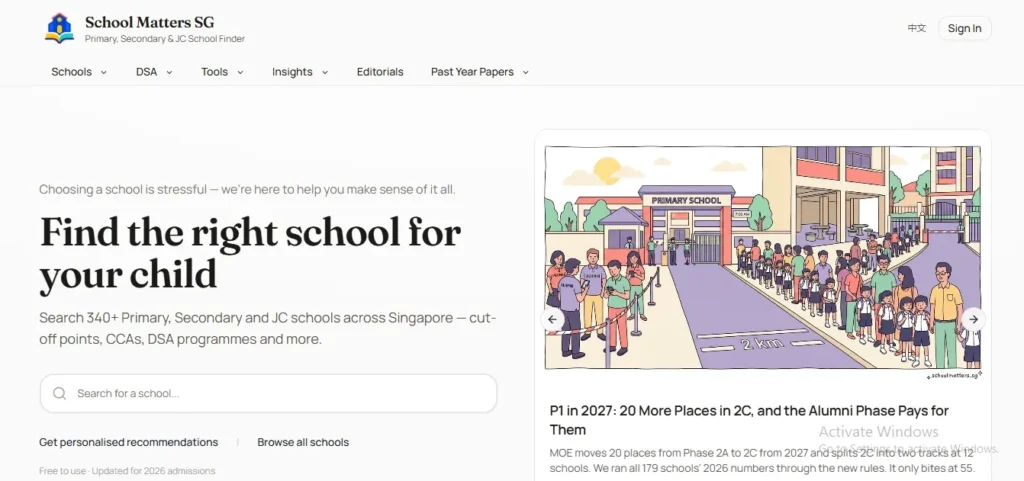
SchoolMatters.sg stands out because it doesn’t rely on a single number to build its primary school ranking. Instead, it scores every primary school in Singapore on a basket of data points, including P1 ballot demand across years and phases, secondary school affiliation, SAP and GEP centre status, CCA breadth, and recent National School Games and SYF results. This multi-factor approach gives a fuller picture than demand alone.
Overview
The site is built specifically for Singapore parents navigating P1 registration. Rather than presenting a fixed “Top 10” that never changes, it lets you weigh different factors depending on what matters to your family. It openly states that there is no official MOE ranking and that popularity-based lists can be circular, since a school becomes popular partly because it is already popular.
Why We Selected Them
- Transparent methodology instead of a vague “editor’s pick” list.
- Regularly updated with current-year P1 data.
- Covers nearly all government and government-aided primary schools.
Key Services
- Full primary school ranking table for 182 schools.
- Filters by SAP status, GEP history, and affiliation.
- Historical P1 balloting data by phase.
Highlights
- One of the few sites explaining why a primary school ranking metric was chosen.
- Clear distinction between former GEP centres and current Advanced Module schools.
Pros
- Multi-factor scoring reduces reliance on hype.
- Useful for both popular and lesser-known schools.
- Good for families comparing more than one district.
Best For
Parents who want a broader, more balanced primary school ranking rather than a single popularity number, especially if they’re weighing several schools across different planning areas.
| Information | Details |
|---|---|
| Website | schoolmatters.sg |
| Focus | Data-based primary school ranking |
| Coverage | 182 primary schools |
| Update Frequency | Annual, aligned with P1 registration |
| Specialization | Multi-factor scoring (demand, SAP, GEP, CCA, affiliation) |
| Best For | Parents wanting a holistic comparison |
SG School Kaki
Why We Ranked It #2
This resource takes a narrower but very transparent approach to primary school ranking. It orders all 179 primary schools by Phase 2C balloting demand, noting that Phase 2C is the phase where every remaining citizen and permanent resident child competes on equal footing, which is why the site uses it rather than academic results as its ranking measure.

Overview
The strength of this site is honesty about what its numbers actually mean. Princess Elizabeth Primary School was noted as the most contested school in 2026, at close to four times subscribed in the open phase. That kind of figure tells parents about competition, not necessarily academic quality — and the site is upfront about that distinction.
Why We Selected Them
- Single, easy-to-understand metric.
- Clear explanation of why Phase 2C is used as the fairest comparison point.
- Separate tracking for former GEP centres and current Advanced Module schools.
Key Services
- Full Phase 2C demand table for all primary schools.
- Year-on-year comparison of balloting figures.
- Breakdown of GEP and Advanced Module school data.
Highlights
- Notes that not a single school appears on both the GEP and Advanced Module lists.
- Straightforward numbering makes it easy to reference in conversations with other parents.
Pros
- Simple, single-metric primary school ranking that’s easy to explain.
- Useful for gauging real competitiveness at P1.
- Regularly refreshed each registration cycle.
Best For
Parents who want a fast, no-frills answer to “how competitive is this school” without wading through multiple weighted factors.
| Information | Details |
|---|---|
| Website | sgschoolkaki.com |
| Focus | Balloting-demand primary school ranking |
| Coverage | 179 primary schools |
| Update Frequency | Annual, post-P1 registration |
| Specialization | Phase 2C demand tracking |
| Best For | Parents assessing entry competitiveness |
KiasuParents
Why We Ranked It #3
KiasuParents earns its place not through a formal scoring system but through community weight. The site tracks which primary schools are attracting the most search interest based on Google search data for primary school-related keywords, while explicitly noting that search volume alone does not indicate that a school is better in any way.

Overview
This is less a primary school ranking in the traditional sense and more a pulse check on what Singapore parents are currently curious about. It works well alongside the two data-driven sites above, since it adds context about parent sentiment and current conversation topics.
Why We Selected Them
- Long-standing, active Singapore parenting community.
- Cross-checks school details against MOE and official school websites.
- Frequently updated with current-year school programme information.
Key Services
- Search-interest tracking for individual primary schools.
- Detailed school profile pages with CCAs and programmes.
- Active discussion forums for first-hand parent experiences.
Highlights
- Flags notable school recognitions, such as Apple Distinguished School status for continuous. innovation in learning and teaching.
- Encourages parents to verify details against official sources rather than relying on the list alone.
Pros
- Strong community input alongside data.
- Useful for programme-level details, not just admission numbers.
- Good starting point for parents new to the P1 process.
Best For
Parents who want to pair a primary school ranking with real parent discussion and day-to-day school culture insights.
| Information | Details |
|---|---|
| Website | kiasuparents.com |
| Focus | Search-interest and community-based insights |
| Coverage | Selected high-interest primary schools |
| Update Frequency | Ongoing, community-driven |
| Specialization | Parent forums and school profile detail |
| Best For | Parents wanting community context, not just numbers |
How We Selected These Websites
We didn’t rank these sites on traffic or design alone. Each was assessed against factors that matter specifically for a primary school ranking resource.
| Evaluation Factor | Why It Matters |
|---|---|
| Data Transparency | Parents need to know exactly what a primary school ranking measures — demand, results, or opinion |
| Update Frequency | P1 registration figures change yearly, so outdated data misleads parents |
| Coverage | A useful primary school ranking should cover most or all government schools, not a select few |
| Honesty About Limitations | Trustworthy sites clearly state that no official MOE ranking exists |
| Community Value | Forums and discussions add context numbers alone can’t provide |
| Ease of Use | Parents under P1 registration deadlines need clear, scannable tables |
| Source Verification | Reliable sites cross-check claims against MOE and school websites |
| Reputation Among Parents | Long-term trust built through consistent, accurate updates each cycle |
Comparison by Key Features
| Feature | SchoolMatters.sg | SG School Kaki | KiasuParents |
|---|---|---|---|
| Data-Driven Methodology | Excellent | Very Good | Good |
| Ease of Understanding | Very Good | Excellent | Good |
| School Coverage | Excellent | Very Good | Good |
| Community Discussion | Good | Good | Excellent |
| Update Consistency | Very Good | Very Good | Very Good |
| Transparency on Limitations | Excellent | Excellent | Very Good |
How to Choose the Right Primary School Ranking Resource
Consider the Methodology First
Not every primary school ranking measures the same thing. Some track admission demand, others track exam-linked designations like SAP or GEP status, and others simply track search popularity. Know what you’re actually reading before drawing conclusions.
Check How Recent the Data Is
P1 balloting figures shift every year based on birth rates, HDB estate changes, and sibling priority numbers. A primary school ranking from three years ago may no longer reflect current competitiveness.
Cross-Reference Multiple Sources
No single site has a monopoly on accuracy. Comparing a primary school ranking across two or three sources — as this guide does — gives a more reliable picture than trusting one list alone.
Look Beyond the Numbers
Distance from home, CCA offerings, school culture, and your child’s temperament matter as much as any primary school ranking position. A highly ranked school that’s an hour’s commute away may not be the right fit.
Verify Against Official Sources
Always confirm details on MOE’s SchoolFinder or the school’s own website before making final decisions. Third-party sites are useful starting points, not final authorities.
Benefits of Using a Reliable Primary School Ranking Resource
Saves Time During a Stressful Period
P1 registration involves tight phases and deadlines. A well-organised primary school ranking table lets you shortlist schools quickly instead of researching each one individually from scratch.
Reduces Decision-Making Anxiety
Knowing the actual balloting odds or designation status of a school helps parents set realistic expectations, rather than fixating on one “dream school” that may be statistically out of reach.
Supports Better Conversations With Other Parents
Having a shared reference point, such as a transparent primary school ranking table, makes it easier to compare notes with other families going through the same process.
Helps Balance Ambition With Practicality
Good ranking resources show both highly competitive schools and steadily strong, less contested options — helping parents avoid over-focusing on a handful of famous names.
FAQs: Primary School Ranking
Is there an official primary school ranking in Singapore?
No. MOE does not publish an official ranking of primary schools, and any “Top 100” or “Best Schools” list found online is not based on official MOE data. Third-party sites use their own methods, such as balloting demand or search interest, so it’s worth understanding each site’s approach.
What is the most common measure used in a primary school ranking?
Many sites use P1 Phase 2C balloting demand, since this is the phase where every remaining citizen and PR child competes on equal footing. Others combine this with SAP or GEP status, secondary school affiliation, and CCA achievements for a broader score.
Does a high primary school ranking mean better academic results?
Not necessarily. A high position often reflects demand or popularity rather than confirmed academic outcomes, since MOE does not release school-level PSLE results publicly.
How often does a primary school ranking change?
Most sites update annually after P1 registration closes, since balloting figures, vacancy numbers, and demand patterns shift each year based on new data.
Should I choose a school based only on its ranking position?
No. Location, CCA fit, school culture, and your child’s personality should weigh just as heavily as any primary school ranking. A slightly lower-ranked school closer to home may suit your family better.
What does SAP status mean in these rankings?
SAP (Special Assistance Plan) schools offer a stronger bilingual and Chinese-language environment. Many primary school ranking lists highlight SAP status separately since it appeals to a specific group of parents rather than being a universal marker of quality.
Are GEP-linked schools always at the top of a primary school ranking?
Historically yes, since former GEP centres attracted high demand. However, MOE has shifted the Gifted Education Programme structure, so newer rankings track “Advanced Module” centres separately, and these don’t always overlap with the old GEP list.
Can I trust search-interest data as a primary school ranking?
It’s useful context but not a full ranking on its own. Search interest shows what parents are curious about, not which school performs better, so it works best alongside demand-based or data-driven sources.
Conclusion
Searching for a primary school ranking in Singapore can feel overwhelming once you realise there’s no single official list to rely on. What matters is choosing sources that are transparent about their methodology and honest about their limitations.
SchoolMatters.sg offers the most balanced, multi-factor primary school ranking for parents comparing several schools at once. SG School Kaki gives a clear, single-metric view based on balloting demand for those who want a quick reference. KiasuParents adds community context and real parent discussion that pure data can’t capture.
Used together, these three resources give a far more complete picture than any single primary school ranking ever could. Cross-check the numbers, verify details against MOE’s official sources, and weigh location and school culture just as heavily as any position on a list. If you’re currently going through P1 registration, start with these three sites, compare their figures side by side, and build a shortlist that fits your family’s real priorities — not just the highest number on a chart.